Who's the Best for No-Code Solutions: Flowforma vs Process Street
Most teams evaluating no-code platforms still face gaps in compliance tracking and audit proof, even after deployment. Those shortfalls turn into policy violations or failed audits when a process breaks. The comparison below delivers a direct verdict on where Flowforma and Process Street each fall short or hold up.
By the final section readers will know which platform enforces policies at scale, supports AI-based risk checks, and produces audit-ready records without extra tools. They will also see the exact feature and pricing differences that decide the choice for their workflow needs.
Quick Verdict: Process Street Wins for No-Code Solutions
Process Street delivers faster no-code workflow automation with built-in compliance tools that Flowforma's generic platform lacks. The platform provides audit-ready features that standard BPM systems struggle to match, creating clearer accountability across business processes.
Process Street helps teams maintain consistent standards through structured workflows that adapt to specific requirements. This approach reduces the complexity often found in traditional business process management solutions.
Research suggests companies benefit from platforms that combine ease of use with strong compliance capabilities. Process Street meets these needs through its SOC 2 Type II and ISO 27001 certifications, along with HIPAA and GDPR compliance options.
Data security remains a priority for many organizations handling sensitive information. Flowforma offers general BPM capabilities while Process Street provides these verified compliance features that support regulated industries.
Teams selecting between these platforms should consider their specific audit and documentation requirements. Process Street's approach addresses both automation needs and compliance standards in a single integrated solution.
At a glance: how Process Street compares to Flowforma on the features that matter most.
| Feature | Process Street | Flowforma |
|---|---|---|
| No-Code Solutions | ✓ | ✓ |
What Is Process Street?
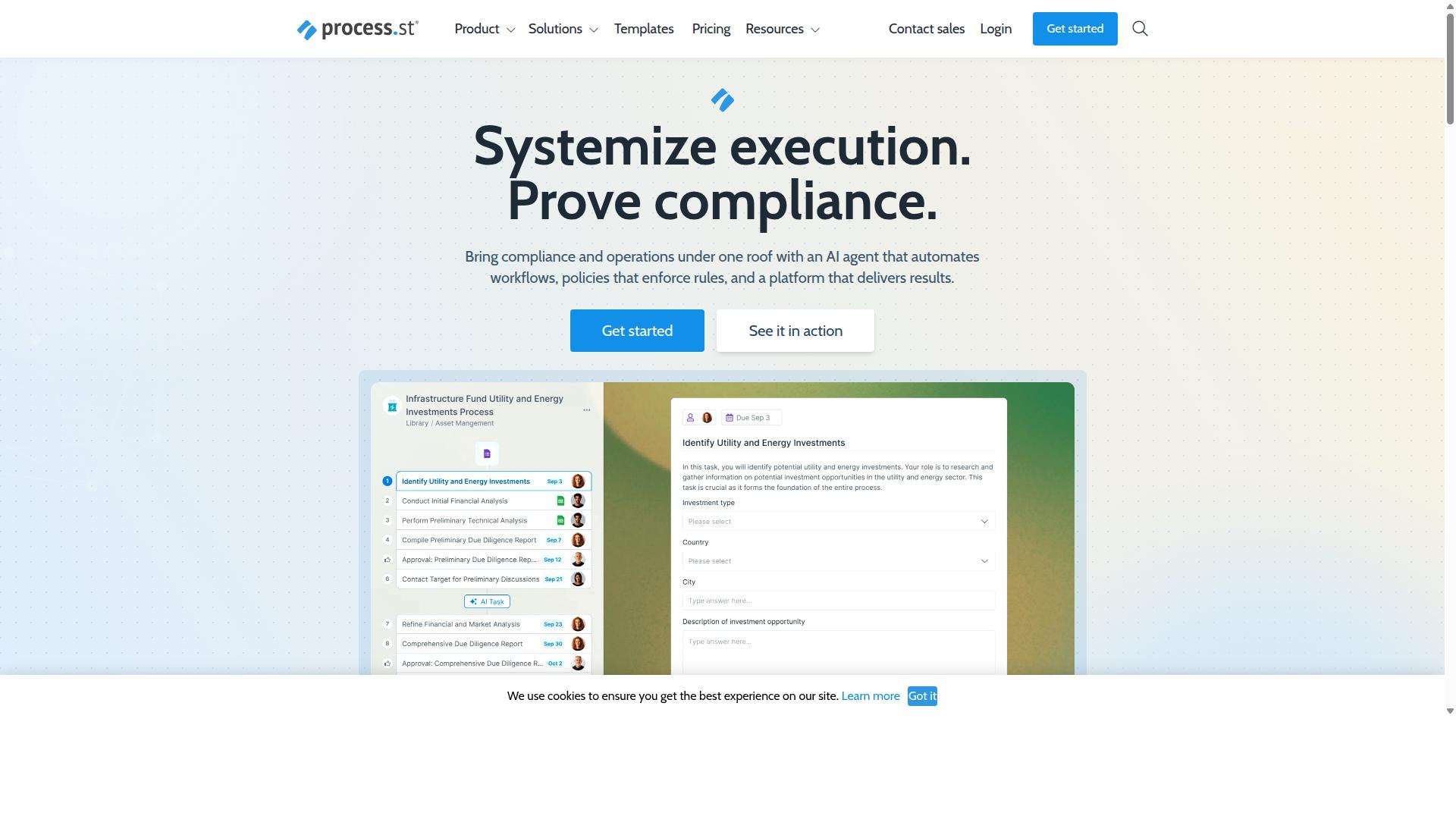
Process Street is a compliance-first operations platform that turns policies into automated, audit-ready workflows. The platform helps organizations standardize processes and maintain operational consistency across industries.
Process Street offers three main products designed for different aspects of business operations. Docs handles document management and policy control. Ops manages workflow automation and process orchestration. Cora serves as an AI compliance and risk agent.
These products work together to deliver audit-ready proof and enforce policies throughout business operations. Organizations can use the platform to prove compliance and keep processes standardized across teams.
What Is Flowforma?
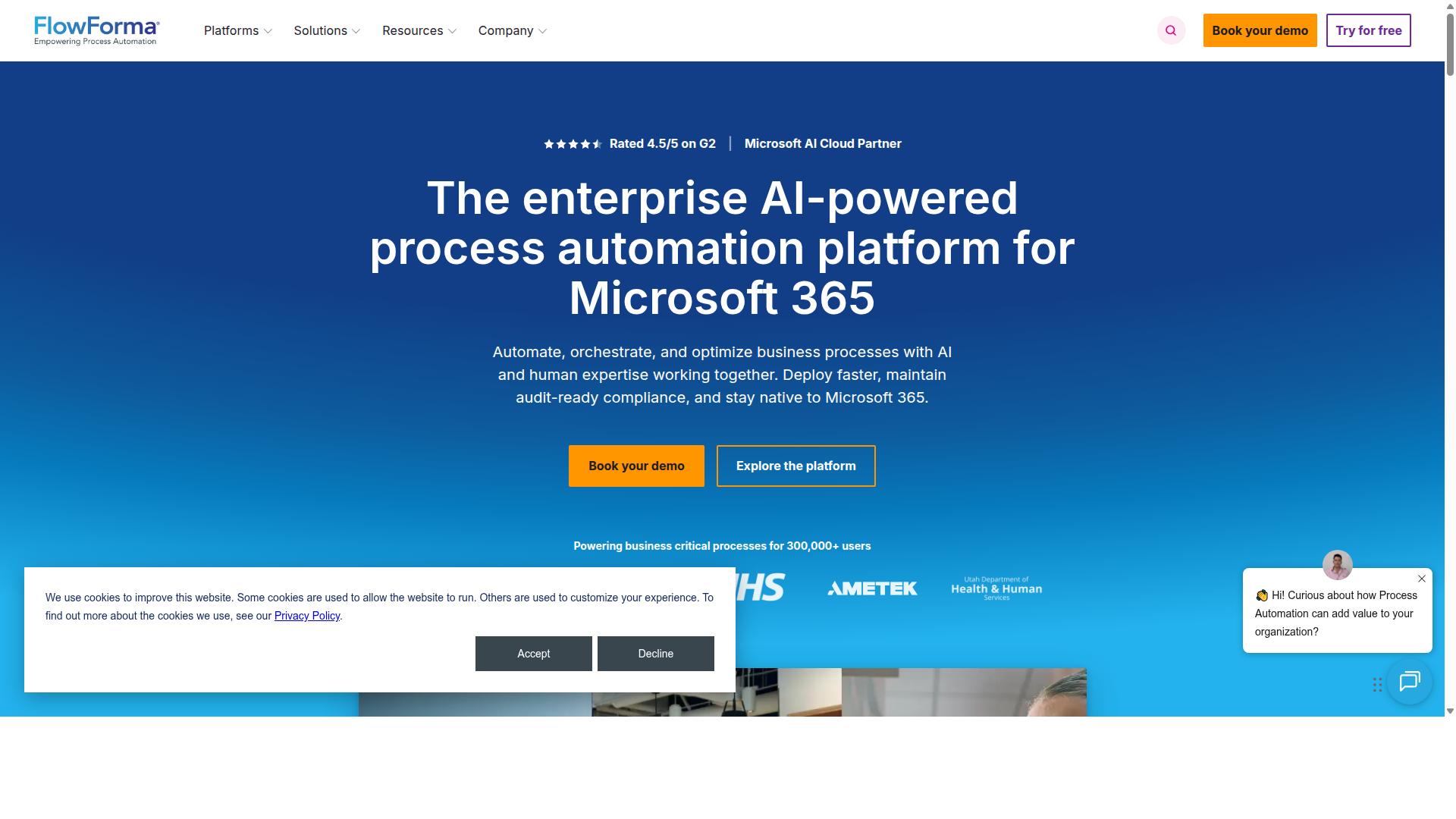
Flowforma is a SharePoint-based no-code BPM tool that lets users build forms and workflows inside Microsoft 365. The platform targets organizations already invested in the Microsoft ecosystem who need to digitize forms and manage approval workflows without writing code. Many teams choose this approach when they want to stay within existing SharePoint sites and Microsoft 365 permissions.
The software provides form builder capabilities that work directly inside familiar Microsoft interfaces. Users can create structured forms and route them for approval using the same security settings already applied across their tenant. This integration style removes the need to manage separate user accounts or permission structures for workflow tools.
Process mapping happens through the same SharePoint environment where documents already live. Teams that store contracts, policies, or records in SharePoint libraries can attach forms and approval steps without moving data between systems. The approach suits organizations that prefer to keep all content inside one Microsoft tenant.
When comparing Flowforma to other no-code platforms, consider how tightly your team relies on Microsoft 365. Organizations with heavy SharePoint usage may find the tight integration helpful, while teams using multiple cloud services might prefer tools that connect more broadly. The choice often comes down to whether staying inside Microsoft boundaries outweighs the flexibility of connecting to other applications.
Features Compared
Three core areas separate the platforms: workflow automation depth, AI-driven compliance monitoring, and document governance.
These capabilities determine how quickly teams can move from policy to execution and how easily they stay compliant.
Workflow Automation & Policy Enforcement
Process Street converts policy documents into AI-powered, conditional-logic workflows that guide users step-by-step.
Process Street turns policy documents into executable checklists using Ops for workflow automation. These checklists include approval routing, conditional logic, and task dependencies that prevent skipped steps.
Users drag and drop form fields, add routing rules, and embed automated checks that enforce business rules at every stage. The platform reduces setup time through pre-built templates and conditional triggers that activate only when needed.
Research suggests teams achieve faster documentation cycles because policies move directly into active processes. Experts recommend this approach for companies seeking consistent policy compliance across departments.
Flowforma offers similar no-code capabilities, yet Process Street provides deeper integration between policy creation and workflow execution through its dedicated automation layer.
AI-Powered Compliance Monitoring
Automated monitoring continuously checks workflow completion against SOC 2, ISO 9001, SOX, and FDA rules.
Process Street uses Cora as its AI compliance agent to monitor regulations in real time. The system captures audit trails automatically and flags risks before they become violations.
Pre-built frameworks cover ISO 9001, SOC 2, SOX, and FDA requirements without custom configuration. The platform maintains SOC 2 Type II and ISO 27001 certifications that validate its security and compliance standards.
Conditional logic built into workflows ensures each compliance checkpoint receives attention at the right moment. Teams receive instant alerts when any step falls outside acceptable parameters.
Flowforma provides basic compliance tracking, yet lacks the dedicated AI agent and pre-configured regulatory frameworks that Process Street delivers through Cora.
Document Management & Audit Readiness
Centralized policy storage with version control and instant export of audit-ready evidence packs.
Process Street uses Docs to centralize policies with full version control across the organization. The system maintains audit trails that update automatically when policies change or workflows complete.
Users generate auditor-ready reports with one click, pulling evidence from completed workflows and stored documents. The platform supports ISO 9001, SOC 2, SOX, and FDA governance requirements through its unified document structure.
Version history prevents outdated policies from circulating while maintaining records of every change. Teams export complete audit packages that include workflow completion data and supporting documentation.
Flowforma handles document storage, yet Process Street offers tighter integration between documents and active workflows through its dedicated governance layer.
Pricing Compared
Process Street offers three transparent tiers while Flowforma pricing is usage-based within the Microsoft ecosystem. The difference matters when teams need predictable costs rather than surprise invoices based on volume.
Process Street's Startup plan suits early stage companies with limited budgets. This tier includes unlimited workflows and tasks, five users, ten guests, and ten automation apps. Teams receive 100 automation actions per month and 50 Public API calls monthly.
The Pro plan removes most restrictions for growing organizations. Companies get unlimited workflows and tasks, up to 10,000 Data Set records, and custom numbers of users and guests. Automation and API limits become fully customizable to match business needs.
Enterprise customers access custom Data Set records and unlimited Public API access. This tier includes a dedicated Success Manager, priority support, and fully managed workflows. Additional services cover custom integrations, bulk document import, and process consulting with health audits.
Flowforma operates on a different model that ties costs to usage within Microsoft environments. Organizations typically pay based on transaction volume or user counts, which can fluctuate monthly depending on business activity levels.
Teams comparing these approaches should consider their workflow volume and growth trajectory. Process Street's fixed tiers provide budget clarity, whereas usage-based pricing may suit organizations with highly variable process demands.
Who Should Choose Process Street
Teams in regulated industries needing audit-ready workflows and policy enforcement choose Process Street. These organizations include operations, compliance, HR, finance, and IT teams across financial services, healthcare, manufacturing, and other regulated sectors.
More than 3,000 companies and 1 million users rely on this platform for structured process management.
The platform serves multiple industries including real estate, professional services, technology, capital markets, and property management.
Common applications include employee onboarding, client onboarding, ISO compliance, quality tracking, document control, and custom workflow creation.
Process Street provides tools that these teams need for maintaining consistency and meeting regulatory requirements in their daily operations.
Who Should Choose Flowforma
Organizations already invested in Microsoft 365 and SharePoint often select Flowforma for lightweight, in-platform automation.
Teams that rely heavily on existing Microsoft infrastructure find this approach reduces the need for additional platforms. Native integration with familiar tools helps maintain consistency across documents and data sources.
Flowforma suits environments where basic form routing and simple approval workflows meet current requirements. Companies seeking minimal disruption during rollout appreciate the ability to build processes inside tools already in use.
Smaller teams or departments with limited technical resources may prefer this option when complex customization is not required. Basic compliance needs can often be addressed without introducing new systems or extensive training programs.
However, organizations anticipating future growth or more sophisticated process demands may encounter limitations. Scaling beyond simple form-based workflows can require workarounds or external solutions.
Process Street offers broader flexibility for teams that need advanced workflow automation beyond Microsoft-centric constraints. Drag-and-drop process builders and extensive template libraries provide options for complex approval workflows, task management, and cross-platform integrations.
Businesses prioritizing scalability, detailed reporting, and audit trails often find greater long-term value in solutions designed specifically for comprehensive business process management rather than platform-specific automation.
Final Verdict
Process Street's compliance-first, AI-powered platform outpaces Flowforma for teams that must prove policy adherence. Three factors separate the two platforms in this space. Audit-ready automation, AI compliance monitoring, and transparent pricing create a clear advantage.
SOC 2 Type II and ISO 27001 certifications establish Process Street as a secure option for enterprise needs. These standards matter when teams manage sensitive data and require documented controls. Flowforma's certification status remains less transparent in public materials.
AI features within Process Street enhance compliance monitoring without using customer data to train models. This approach protects privacy while maintaining operational efficiency. Organizations handling regulated information benefit from these built-in safeguards.
Transparent pricing lets teams understand costs upfront without hidden fees or complex tiers. Teams already using AWS infrastructure can access Process Street through the AWS Marketplace, which simplifies procurement and integration processes.
Recommended Resources: